Life transition coaching For people who have outgrown the life they built.

From the outside nothing may be wrong, and you may even have the salary, the title and the recent promotion to prove it, but you have begun to suspect that the life you built, with its work, its routines and the expectations you inherited along the way, no longer fits who you have become, and you cannot see what should replace it. It is usually an event that makes the question urgent, such as a redundancy, a separation, a move, a milestone birthday or a promotion you were not sure you wanted, or simply the evening you notice that the income keeps growing while the time to enjoy it keeps shrinking, and you admit that another ten years like this is not acceptable.

How the work unfolds

Private online coaching in two stages. In the first we reach a decision about your direction that you can trust, using your values, your real circumstances, the honest trade-off between income and free time, and small tests in the real world; in the second, for those who want to work for themselves, we build the business. The habits and the confidence that have to carry the change are part of both, and each stage stands on its own, so you begin with the one you are in and take only what you need.

A conversation on Zoom, with no obligation. If I am not the right person to help, I will tell you.

Build a bigger comfort zone

If you are quieter or more reflective than the people who usually give this kind of advice, you will not be asked to become louder or to perform a confidence you don't feel.

Doctorate
PhD · education policy
Coaching
ICF-trained · evidence-based
Practice
Independent · since 2019
Measure
Progress tracked · from week one
“You do not have to leave your comfort zone. You have to make it larger, deliberately, one step at a time.”

Constantine Samartzis, PhD · the idea behind the practice

02 — How the work unfolds

Two stages, each a path of its own.

Each stage is a complete piece of work with its own page, and you can take one on its own or both in order; taken together they form the Life Transition Programme. Whichever you choose, the coaching is private and online, and we begin with a clear baseline and review a few observable measures together every few weeks.

iStage oneOn its own, or as the first stage

Direction: a decision you can trust

When you cannot yet see where your life should go.

This is where the uncertainty is taken seriously. We look back at what has given your life energy, look honestly at your values and circumstances, and test two or three possible directions in small, safe ways, rather than reasoning about them for another year.

It ends with

a direction you have chosen deliberately, written down, with your reasons and the evidence beside it.

  • Values
  • Strengths
  • Small experiments
iiStage twoOn its own, or after Direction

Launch: a business of your own

When you already know that you want to work for yourself.

This is for solopreneurs and one-person service businesses, and you can begin here directly if your direction is already clear. I teach you to build each part yourself, in the order I built my own practice in 2019, from a clear niche and an offer people understand to a website you make with your own hands, search visibility and the calm conversation that turns an enquiry into a client.

It ends with

a small business you understand completely, because you built every part of it yourself.

  • Niche
  • Offer
  • Website
  • First clients

If you are not sure which of the two is yours, that is what the free consultation is for. We decide together where to begin, nobody is asked to take a stage they do not need, and how long each one lasts depends on what you bring to it. If what you need first is steadier habits and quieter confidence rather than a new direction, that work also stands on its own.

03 — Evidence

Progress you can see, not a feeling you hope for.

We begin with an honest baseline and agree on a small number of things worth tracking. They are not vanity metrics; they are observable signs that your life is moving the way you want, and every few weeks we look at them together, so that neither of us has to rely on a vague feeling about whether anything is changing.

  • Directions tested
  • Decisions taken
  • Gym sessions kept
  • Nights asleep on time
  • Experiments completed
  • Free evenings protected
  • Enquiries received
MeasureWeek by weekTotal
Directions testedDirection3
Real-world experiments completedDirection6
Career or business decisions takenDirection4
Prospective clients spoken toLaunch9
  • Done
  • Partly
  • Not yet
In practice

Not a spreadsheet of your life. A few honest numbers, reviewed together.

An illustrative example, not client data.

04 — The method

A transition touches more than one part of a life.

καλοκαγαθίαkalokagathia

The Greeks had a word for a life in which body, mind and character develop together, each making the others possible. That is why I look at four connected areas, although we never work on all of them at once: we begin with the one that is most strained or most ready to change, and let the progress there make the next one easier.

i.

Body

The energy and steady routines a demanding transition has to run on: sleep, training and recovery that survive a real working week, so that exhaustion does not make your decisions for you.

Sleep. Training. Recovery.

ii.

Mind

Confidence, attention and the habits of thought that either widen your choices or quietly keep your life small, worked on without asking you to be relentlessly positive.

Confidence. Focus. Decisions.

iii.

Work

Direction and meaningful work, and for many people the move to working for themselves: the plan, the offer, the website and the systems that keep work and life from colliding.

Direction. Independence. Systems.

iv.

Life

The unscheduled time, the hobbies, the friendships and the ordinary pleasures that a demanding career quietly crowds out, because a successful working life means little if there is no time left to live it.

Friendship. Belonging. Pleasure.

You do not have to work on all four, and most people shouldn't try. But a change made in one area always reaches the other three, so we keep all of them in view, and that is usually where the most lasting progress comes from.

05 — About

I have made this kind of transition myself, slowly and more than once.

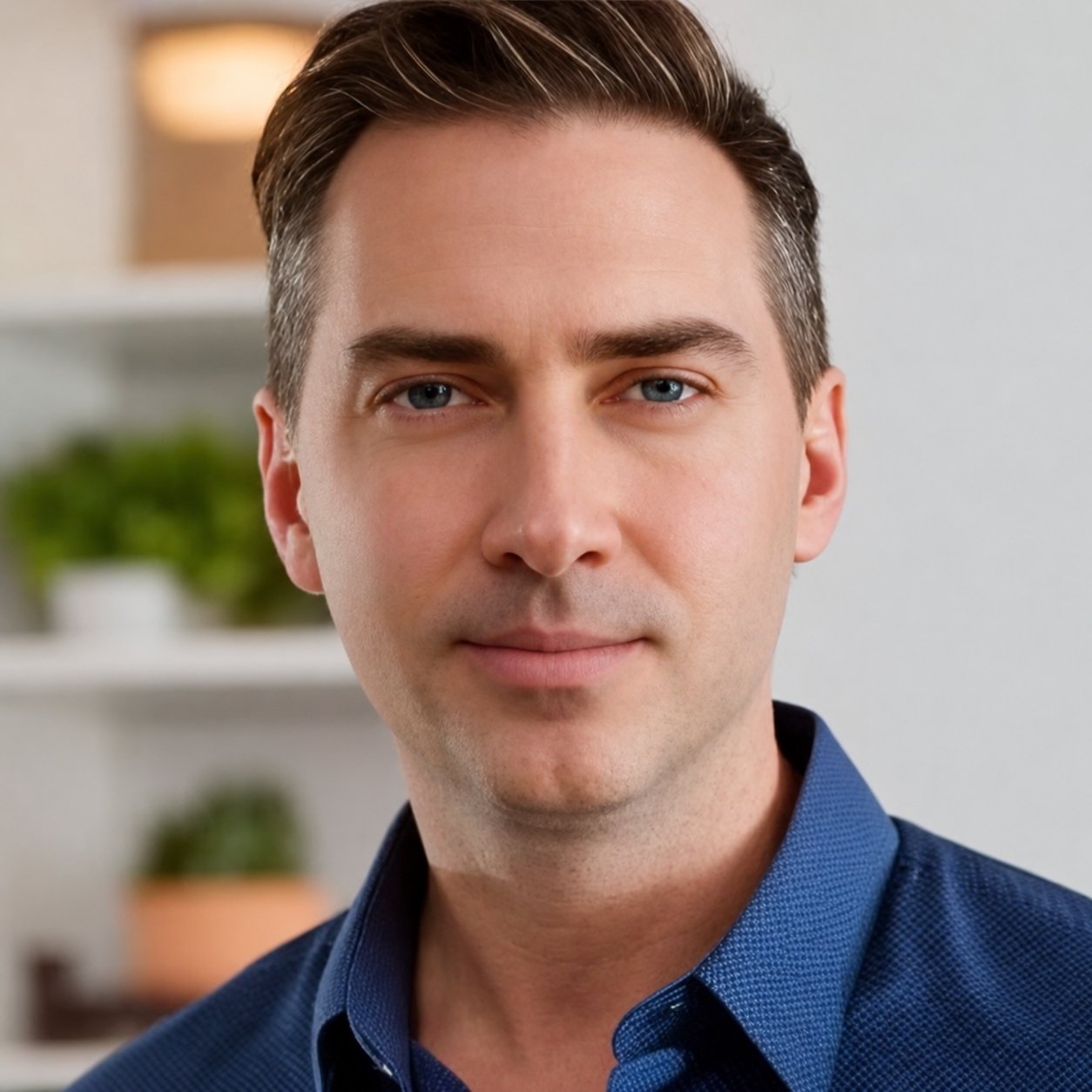
Constantine Samartzis, PhD, life transition coach, in Rhodes
Constantine Samartzis, PhD Rhodes, Greece · working online with clients worldwide

Some years ago I was overweight, I was procrastinating over a doctorate I had started long before, and I was teaching in a job I had stopped believing in. From the outside nothing looked wrong, which is exactly why it was so easy to postpone, and most of the advice I came across asked me to become louder, more relentless and more conventionally ambitious than I am.

So I began to rebuild, deliberately and in small steps. I started with my body and lost fifteen kilos by rebuilding my routines around training and sleep, then I finished the doctorate I had delayed for years and wrote a guide that became an Amazon bestseller. In 2019 I left salaried teaching to build an online practice of my own, from the website to the first clients, which is the transition most of the people who write to me are now considering.

None of it came from becoming someone else. It came from working with my temperament rather than against it, from measuring what changed so that I could believe it, and from accepting that a life with several interests in it, from education policy and training to writing and classical music, can be composed rather than reduced to one.

That is what I bring to our work: the habit of checking what the research actually says, a coach's training in asking the questions you have been avoiding, and the experience of having stood where you may be standing now. I will not tell you the way is easy, but I can help you take it deliberately, and in a way that still feels like your own life.

  • PhD · Education policy
  • ICF-trained coach
  • Trained in exercise science and nutrition through NASM
  • Independent practice since 2019
i · Body

15kg

Lost and then rebuilt through training, structure and consistent practice.

ii · Mind

PhD

Completed in education policy after years of delay and resistance.

iii · Work

2019

The year I left salaried teaching and built an online practice from nothing.

iv · Writing

№1

A self-published guide that became an Amazon bestseller.

06 — Questions

Before you book.

Short answers to what people usually ask before the first conversation. If your question is not here, bring it to the consultation or write to me.

What happens in the free consultation?

We spend thirty minutes on Zoom talking honestly about where you are, what has been stalling and what you would like to be different six months from now. If I don't think I am the right person to help, I will tell you so, and if I am, you will leave knowing what the first steps would be, whether or not you decide to work with me.

What if I do not know what I want to do with my life?

That is the most common starting point, and it is exactly what the Direction stage is for. We begin with what you already know about yourself, from your values to the moments in your past that felt most like you, and turn it into two or three directions small enough to test in ordinary weeks, so that the answer is something you have tried rather than something you have guessed.

Is this therapy?

No. Coaching is concerned with the present and with the next practical steps, rather than with examining the past in depth, and it is not medical or psychological treatment. If something you describe would be better served by a clinician, I will say so plainly.

How is this different from career coaching?

Career coaching usually concentrates on CVs, LinkedIn profiles and interviews for a role you have already chosen. This work starts one step earlier, with your values, the real trade-off between income and free time, and small, low-risk experiments that test a next chapter before you commit to a move, a new role or a business of your own.

Do I have to take both stages?

No. Many people come only for Direction, because they want clarity about a career change or a better quality of life while staying in their job, and others already know their field and begin directly with the solo business stage. We decide together in the free consultation where it makes sense to begin.

How long does it take?

Most people work with me for around eight to twelve sessions over about three months, weekly or fortnightly so that it fits a normal working life. We agree the scope and rhythm together in the free consultation, the number is a guide rather than a contract, and if a shorter piece of work makes more sense for where you are, I will tell you plainly.

What does it cost?

Fees depend on the shape of the work and are explained in the free consultation, so that you are never asked to decide from a price list before we have spoken.

Where are you, and in which language do we work?

I live on Rhodes, in Greece, and work privately online with people in many countries. Sessions are held in English on Zoom.

The first conversation

A consultation is the first piece of work.

Thirty minutes on Zoom, free and without obligation. You don't need to arrive with a perfectly formed goal; we will talk about where you are, what has been stalling and what you would like to be different six months from now.

Scroll to Top